We welcome Volunteers on field trips and expeditions in the Maya area of Mesoamerica
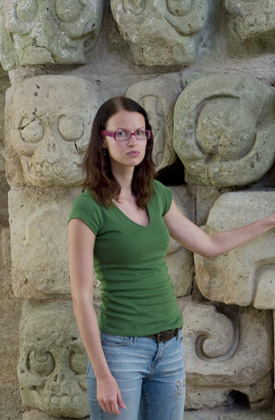 |
| Volunteer Tina Košir at Copan Ruins ,Honduras |
Experience foreign cultures, explore ancient cities, meet other like-minded people of all ages and backgrounds.
Most archaeologists accept volunteers, but usually these assistants are their students from their home university. In the last ten years, however, expeditions have increasingly accepted people other than students. So like colleges, museums, and other comparable research expeditions, our archaeology research institute also includes a program whereby volunteers contribute towards the overall cost of the expedition. Their financial contribution makes the expedition possible to begin with; the help of the volunteers during the expedition keeps things going.
Most of the students who have worked on FLAAR. projects in the past have come from leading German universities. Ability to speak German is a plus when working with FLAAR. but is not an absolute necessity since we all speak English. For the past two years volunterrs have been from Slovenia. Presently one volunteer, in 3D visualization of Maya temple pyramids, is from the Ukraine.
Spanish is also of obvious use, but you can learn this in Guatemala rather quickly, so is not a requirement.
The US Congress has eliminated virtually all funding for arts and the humanities.This means that archaeology expeditions receive no federal funding, and state governments do not finance field trips to remote foreign countries. Most foundations are financing AIDS research, helping the homeless, or providing funds only to projects of political priorities. This means that your contribution is what can make the difference in archaeological research.
The typical cost for a student is between $1000 and $2000, and for a non-student between $1500 and $5000 (average is $2500). Since we are not a travel agency, this does not include airfare. You purchase your own plane ticket at your own neighborhood travel agency. In some instances, if you have a pertinent capability such as 3D rendering, 3D scanning or are doing a thesis on a topic in which FLAAR is also interested in, in such a case the fee would be waived (but in most instances you would need to cover your airfare).
In recent years volunteers have worked with FLAAR. in Mexico, Belize, Guatemala, Honduras, Japan, and Germany. Yes, FLAAR had a project with Japan's National Museum of Ethnology related to advanced digital imaging in archaeology and anthropology. We are also working on programs to assist archaeologists in Guatemala, Honduras, Belize, and Mexico to develop increased capabilities with computer aided design, digital imaging, and photography. If you would like your donation to make a lasting impact, please work with us to bring these programs of international multi-disciplinary cooperation to fruition. CORPORATIONS, especially companies which manufacture computer hardware or software have been most helpful in donating equipment and materials to assist FLAAR.
Occasionally individuals indicate to us that they wish to fund their own expedition. This can cost between $30,000 and $300,000, depending on what archaeological goals you wish to accomplish. $100,000 can get a major archaeological project started. This sum is tax deductible as a donation to scientific research. (keep in mind that our staff archaeologists often away for months in remote locations or lecturing worldwide, so we may be a bit slow in replying).
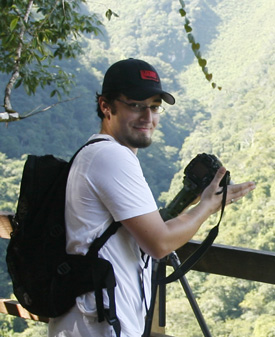 |
| Volunteer Alen Bubanja at Cemuc Champey, Verapaz |
Include pertinent information: when you are available, for how long, and an indication that you have an awareness of the financial situation (in other words, that each volunteer covers their own costs as well as contributing towards the overall expedition).
Latin American is a great place to travel (just be aware of the reality). You can take language courses before or after your volunteer stint.
It is required that you have health insurance and medical evacuation insurance.
Please also express an awareness of the physical, mental, and medical problems that you can expect on an expedition. No hospitals are nearby; no medical personnel whatsoever are on the expedition. If out in the jungle there is no phone contact, not even radio! If you are squeamish, please do not apply. If you are nervous about remote foreign countries, you should opt to stay in the safety of your own home. If you wish to sample a more adventurous lifestyle, join an archaeologist to experience the past.
FLAAR does not engage in archaeological excavation because we already have done this in past decades. Our projects for 2008-2010 are in tropical flora and fauna related to Maya culture (ethnobotany and ethnozoology). We also are interested in minerals used by the Maya, such as iron pyrite and cinnabar.
e-mail is [email protected]